By Jenna Stephenson
Introduction
Although the potential ramifications of climate change have been circulating since the 1960s, there has been a distinct lack of inaction on the part of global government. Ignoring the long-term consequences of climate change in favor of short-term economic growth powered by fossil fuels is catching up to the world of international relations. Repeating past failures of international environmental law for political brownie points is no longer cutting it in a world where climate change is actively damaging world governments and economies. Furthermore, the climate vacuum left by national governments is being filled by unconventional actors, and the world of international relations will need to adapt to the realities of a world irrevocably transformed by climate change.
Negative Consequences of Climate Change in Global Politics
For decades, climate change has been an abstract problem. There were few aspects of climate change which were easily recognizable for those outside of select scientific fields, and markers like rising temperature were not inherently alarming to the average person. Consequences have arrived, and they will only get worse. The effects of the climate crisis are already costing the world billions of dollars, and this cost will be amplified by climate-based political conflicts.
Rising Cost of Natural Disasters
Climate change is amplifying natural weather patterns to new extremes. In addition to costing human lives, worsening weather events are also costing quite a bit of money. In the last decade, “natural disasters cost the world approximately $2.98 trillion”. Natural disasters are more expensive than ever, and costs will continue to rise as climate change intensifies. While insurance companies often bear much of the cost of climate change, the average citizen also pays for global inaction. In the United States, the average taxpayer now pays nearly ten times as much for federal disaster relief compared to costs in 1990. This creates increasing pressure on politicians to act and mitigate climate change.
Scarcity Conflict
Resource scarcity is a primary cause of conflict, violent or otherwise. As climate change wreaks havoc on the availability of land, food, and water, experts have begun to strongly examine the link between environmental problems and civil unrest. Resource-related tensions are already building between Ethiopia and Egypt over the Nile River. The proposed Grand Ethiopian Renaissance Dam’s potential effects on Egyptian water supply are already contentious, and erratic rainfall caused by climate change is raising fears of water insecurity. Concerns that climate change could indirectly lead to armed conflict are further corroborated by the locations which will be hit hardest by climate change. Many of the countries most vulnerable to climate change have existing political instabilities which will exacerbate the political costs of climate change.
Climate Migrants
In addition to the refugees created by violent conflict, shrinking amounts of hospitable land also create climate migrants. These are people displaced by increased flooding in coastal areas, toxic air in cities, and extreme drought. According to the World Bank, climate change could displace up to 140 million climate migrants by the year 2050. While climate migrants do not meet the criteria of refugees under current international law, the United Nations human rights committee recently ruled that climate migrants whose lives are threatened by the effects of climate change cannot be returned home. This ruling does not automatically grant climate migrants asylum, but it does present political problems for nations already feeling the strain of extreme weather.
Considerations for Effective International Environmental Law
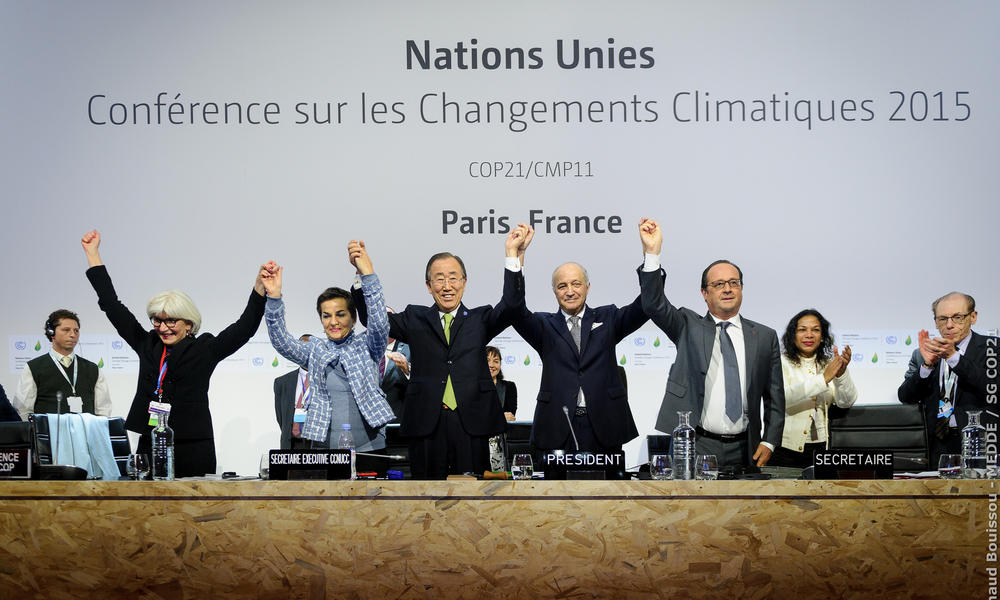
With the exception of the Montreal Protocol, international law aimed at stopping climate change has been an overwhelming failure. Climate negotiations in Kyoto, Copenhagen, and Paris have all produced superficial agreements which lack the teeth to actually meet their collective goals. In order to produce results, future legislation will require key characteristics.
Incentives for Participation
International law is often hampered by its voluntary nature. Unlike individual states, intergovernmental bodies do not have sovereignty over those beholden to its agreements. Instead, the cooperation of nations with international law is often dependent on its benefits to their international reputation versus its drawbacks in regard to independent goals. According to reputation theory, “international law will have a greater impact on economic matters than on military and security matters”. Therefore, the most effective way to incentivize active participation in climate legislation is by tying cooperation directly to non-participating nations’ economic futures. The Montreal Protocol’s success was largely thanks to this strategy: banning trade of controlled substances between participants and non-participants was a cornerstone of the agreement. Completely voluntary participation lowers the risks for states to abandon the agreement in the future and ensures that large economies and carbon emitters like China and the United States are invested in legislation.
Definitive and Scientific Objectives
A common thread in the past two decades of climate negotiations is a general agreement to limit global temperature. In the 2015 Paris Agreement, signatories agreed “to strengthen the global response to the threat of climate change by keeping a global temperature rise this century well below 2 degrees Celsius above pre-industrial levels”. There are benefits to this target temperature: there is a defined point of success and failure, and it is backed by scientific consensus. Unfortunately, this promotes a single goal for every signatory, and painting each nation with such a broad brush severely limits the legislation’s efficiency. Because past international laws have set overall global goals and left specific national targets to individual governments, free-riding is much more appealing than paying economic costs for actual environmental progress. As one professor of Natural Resource Economics at Columbia University puts it, “The problem is that this is a global goal. Everyone is responsible for meeting it, meaning no country is responsible for meeting it”.
To counter this, international law must include targets for each country based on individual carbon emissions and carbon intensity. Additionally, these national goals must add up to a global success. The Paris Agreement failed to account for the contrast between national commitments and international goals, so even if every country meets its commitments, the Accords will still have failed to meet their stated goal. Well-defined targets and limits assist in both enactment and enforcement of environmental accords.
Engagement of Developing Nations
In terms of developing nations, many developed nations recognize their relative innocence in climate change and seek mainly to prevent them from building dependencies on fossil fuels like developed nations did in the 19th and 20th centuries. These goals require money that developing countries simply do not have. Rising global temperatures disproportionately harm the economies of low-income countries, and in many sub-Saharan African countries, climate change has already reduced their GDP per capita by over 20 percent. In order for green development to be practical, it has to be financed by developed economies.
Developed nations also have a responsibility to help developing nations adapt to the present and permanent consequences of climate change. Lowering carbon emissions cannot undo saltwater intrusion in Bangladesh or bring back Nicaraguan coffee crops. Meaningful climate legislation must include climate justice for developed nations who have contributed less to climate change and suffered more.
The Emerging Role of Non-State Actors
Non-profit organizations are motivated by public good, not money, and thus far such organizations have led efforts against climate change outside of federal policy. As intergovernmental inaction becomes a greater threat to lives and livelihoods, self-interest has motivated other actors to carve a place for themselves in environmental progress.
Local Governments
While national actors are the stereotypical purveyors of environmental law, many important facets of climate action start from the ground up. After the United States withdrew from the Paris Climate Accords in 2017, mayors from 446 cities pledged to uphold the commitments their federal government had abandoned. Other examples of subnational climate coalitions include the Under2 Coalition, the United States Climate Alliance, the International Zero Emission Vehicle Alliance, and the Pacific Coast Collaborative. Each of these organizations includes subnational members, and their goals are often more aggressive than agreements produced by national actors. Such agreements have proven especially effective in the United States, where perception of the legitimacy and urgency of climate action can differ by region and municipality.
Corporations
Consumers are providing companies with a growing incentive to go green. In 2014, one study found that 55 percent of global consumers were willing to “products and services from companies that are committed to positive social and environmental impact”. Market incentives for sustainability increase as consumers associate green brands with easy altruism. Take Unilever, for example: their brands which associate themselves with sustainability “are growing 69 percent faster” compared to sales in other areas. As more companies sell products with a limited or reduced environmental footprint, other companies will be forced to adapt to new green norms in order to compete.
Asset Owners
Large investors now include climate change in risk assessments. In the past, ignoring carbon emissions in favor of economic growth powered by fossil fuel made the most fiscal sense. Now, asset owners and their portfolios are starting to feel the effects of climate change. The asset manager BlackRock will now ask every firm in its $7 trillion portfolio to disclose their carbon emissions, and a group of investors known as Climate Action 100+ leverage nearly half of the world’s invested capital to push for reduction of greenhouse gas emissions, carbon neutrality, and environmental disclosure. The private sector does not have the will or the ability to fully combat climate change; however, companies are often more beholden to investors and board members than to politicians.
Conclusion
Global impotence on climate change is no longer economically or politically viable. Developing nations have been struggling with the negative consequences of climate change in relative silence, but as developed nations begin to feel the effects of natural disasters, scarcity conflict, and climate migration more acutely, they will be forced to throw their political power behind substantive climate action. In order to do so, world leaders will need to abandon the false comforts of vague agreements and create international law with compelling incentives for participation, defined and scientific objectives, and appropriate engagement of developing nations. Finally, in failing to act when they had the chance, international governments have given up considerable power to subnational and non-governmental actors who will require a seat at the table to stand a chance against climate change.
What other consequences of climate change will impact the way countries interact? What are some other qualifications of effective international law? Can countries make real progress in fighting climate change, or will the responsibility fall to other groups?
Sources
Websites
https://www.prb.org/environmentalscarcityandtheoutbreakofconflict/
https://foreignpolicy.com/2020/03/14/ethiopia-egypt-gerd-united-states-must-not-pick-sides-in-the-nile-river-dispute/
https://www.worldbank.org/en/news/press-release/2018/03/19/climate-change-could-force-over-140-million-to-migrate-within-countries-by-2050-world-bank-report
https://www.theguardian.com/world/2020/jan/20/climate-refugees-cant-be-returned-home-says-landmark-un-human-rights-ruling
https://unfccc.int/process-and-meetings/the-paris-agreement/the-paris-agreement
https://woods.stanford.edu/news/what-happens-if-we-dont-meet-paris-agreement-goals
http://climatemayors.org/actions/paris-climate-agreement/
https://calepa.ca.gov/intergovernmental-relations-program/
https://www.nielsen.com/us/en/insights/article/2014/it-pays-to-be-green-corporate-social-responsibility-meets-the-bottom-line/
Excerpts from Foreign Affairs, Volume 99 Number 3
“A Foreign Policy for the Climate” by John Podesta and Todd Stern
“The Strategic Case for U.S. Climate Leadership” by James A. Baker III, George P. Shultz, and Ted Halstead
“The Climate Debt” by Mohamed Adow
“The Unlikely Environmentalists” by Rebecca Henderson
Excerpts from Essential Reading in World Politics, 7th Edition
“International Law: A Compliance-Based Theory” by Andrew T. Guzman
“Why Have Climate Negotiations Proved So Disappointing?” by Scott Barrett